

Category Creation for Startups
Early-stage companies create energy—and not simply because they’re young.



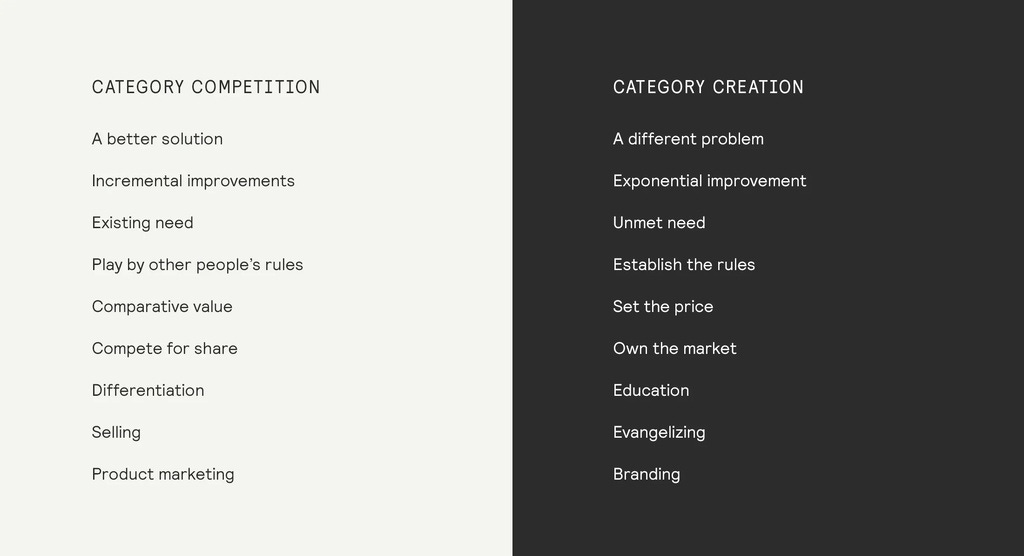
Increasingly, it’s because they’re creating entirely new categories instead of selling new products to compete in existing spaces.
These new categories ignite our imagination and promise us new ways to live, new ways to work, and new ways to experience the world.
For example, it’s probably not the product that has propelled Liquid Death to prominence. It’s that they’re helping us think about plain old water in an entirely new way—in fact, they are redefining what water, and water marketing, mean to consumers.
Similarly, Oura isn’t simply another health tracker, it’s “an entirely new category of health based on signals that are best gathered through your fingers.
Category creation isn’t just another business strategy. It’s a radically different playbook from one most companies follow.
It involves helping people understand that the existing category is focused on the wrong problem and that there’s an entirely different problem to be solved, then orienting everything your company does around the education, solution, and fulfillment of this new market.
This is why category creators are tough to compete against—they are very literally playing a different game.
This approach is not for the faint of heart. It’s a fundamentally different approach from the traditional strategy of category competition that most companies pursue. But the returns are higher. Category creation was shown to account for the majority of incremental growth and market capitalization in one study, and consultant David Aaker views it as the “only way to achieve real sales and profit growth.”
Not surprisingly, category creation also requires a different playbook for marketing. Creating awareness and recognition of a new problem does require more investment in education and explanation than simply introducing a familiar-but-tweaked idea to market. Much of the lifting can be accomplished through community-building, rather than traditional communications. But one surprising difference is the reinvigorated and redefined role of brand in category creation.
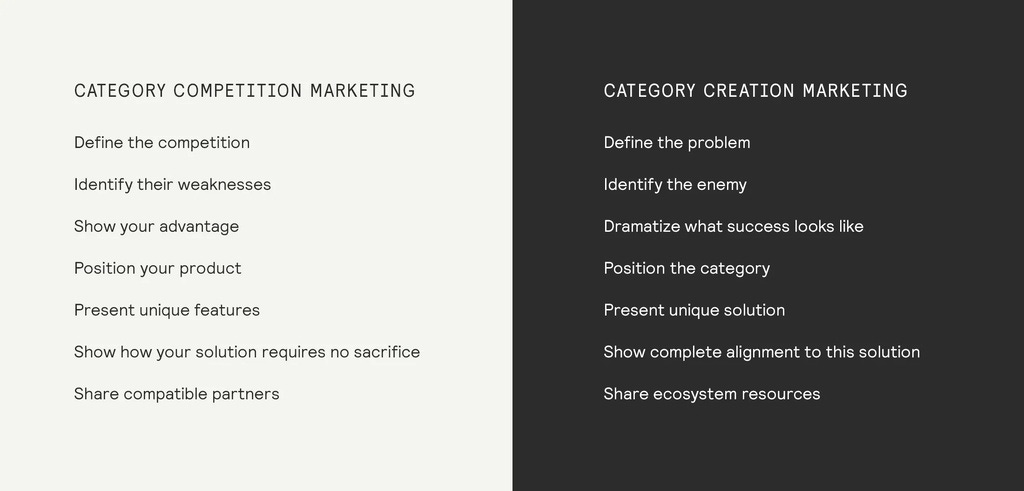
Brands create demand for new categories.
While many believe that the heavy lifting of category creation is done by products or services alone, it’s now more clear that brands are actually the drivers of change. Brands create demand for new categories; products and services fulfill that demand. In almost every single case, the category leaders were not the first to enter their markets; they were the first to brand their markets. They were the first to create emotional, not just functional, connections with their communities and their consumers. They were the first to make us want to live differently. In some ways, this is a return to the glory days of branding, when brands were purveyors of new, fabulous lifestyles. But in other ways, category creator brands are very different.
Category creation also exerts a double penalty upon incumbents and legacy brands. Category creators align with and accelerate cultural shifts that move people away from your brand, while also moving people away from your category. That means defending requires fighting two different battles simultaneously. For incumbents, this often means choosing between fortifying your own brand position or taking on the role of category defender, which also benefits your traditional competitors. Given that speed of reaction is shown to be the only strategy that has seen any success, it’s little wonder that most incumbents are failing to adequately defend themselves against seismic changes to their categories.
For category creators, speed is a defining business characteristic, and an intrinsic quality they bring to category creation. This is why the future is being reshaped so rapidly, and why we believe it will continue to evolve just as quickly for the foreseeable future.
If you’re interested in category creation for your early-stage company reach out to us at hello@demosfunds.io.